
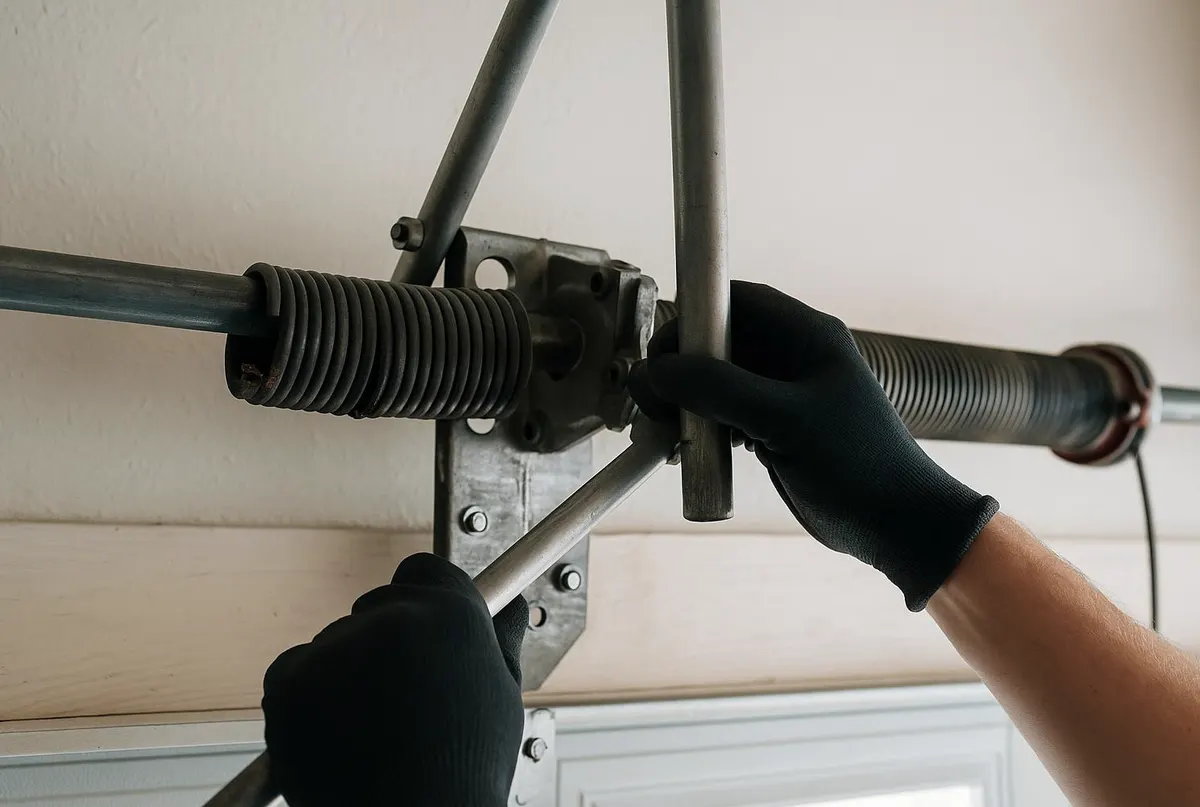
What a Technician Sees on These Calls
Most spring calls in this area start the same way: a homeowner says the door suddenly felt heavy, or the opener started straining and making a grinding noise it never made before. By the time we get there, the spring is usually already stretched, rusted, or down to its last few coils of resistance. The good news is that springs rarely fail without warning. They give off signs for weeks, sometimes months, before they actually let go. The trick is knowing where to look.
Danville's mix of dry, dusty summers and wet winters is hard on exposed metal hardware. Torsion springs mounted above the door and extension springs along the horizontal tracks both go through the same stress cycle: they heat up and expand in summer, then contract in cold, damp winter air. That expansion and contraction, repeated over years, is what eventually fatigues the steel. Here's how to check yours before it becomes an emergency.
The Walkthrough: Checking Your Springs Before They Snap
1. Look for Gaps Between the Coils
Stand under the door (with the opener disconnected or the door closed) and look at the torsion spring on the bar above the door. The coils should sit snug against each other. A visible gap, especially one that wasn't there before, means the spring has stretched under tension and lost some of its holding strength. This is one of the clearest early signs of fatigue.
2. Check for Rust or Pitting
Run your eyes, not your bare hand, along the length of the spring. Surface rust that wipes off with a cloth is cosmetic. Rust that's left pits or flaking in the metal is a different story: those pits are stress points where the spring is more likely to snap under load. Winter rain and the humidity that follows it are the usual cause here, especially if the spring was never coated or lubricated.
3. Look for Stretching in Extension Springs
If your door uses extension springs instead of a torsion bar, check their resting length against how long they were when installed, if you have that reference, or simply look for visible elongation, kinks, or gaps between coils when the door is closed. A healthy extension spring sits with its coils touching. One that's visibly stretched out is losing its ability to counterbalance the door's weight.
4. Run the Balance Test
Disconnect the opener by pulling the release cord, then lift the door manually about halfway. A door with healthy springs will stay roughly in place when you let go. If it drops on its own or shoots upward, the springs are no longer balancing the door's weight correctly. This is one of the most reliable tests because it measures actual function, not just appearance.
5. Listen for New Noises
Popping, creaking, or a metallic twang when the door opens or closes often means a spring is working harder than it should, or that a coil has already partially failed. A grinding sound from the opener motor is a secondary symptom: the opener is trying to compensate for a spring that's no longer doing its share of the lifting.
6. Watch the Opener's Behavior
If your opener seems to strain, pause mid-cycle, or reverse direction before fully closing, it may be fighting a worn spring rather than a motor problem. Openers are built to assist the springs, not replace them, so a struggling opener is frequently a spring symptom in disguise.
7. Inspect the Cables Near the Drum
Fraying or uneven winding on the cables at either end of a torsion spring often shows up alongside spring wear, since the two systems work together to manage the door's weight. Fraying cables combined with any of the signs above means the whole lift assembly needs a closer look.
8. Note the Spring's Age
Most residential springs are rated for a set number of open-close cycles, and many reach the end of that rated life somewhere in the seven-to-ten-year range depending on usage and exposure. If you don't know the age of your springs, or if they predate a recent earthquake retrofit or opener upgrade, it's worth having them checked rather than guessing.
When to Call Danville Garage Door Service
If you spot even one or two of these signs, it's time to get the springs inspected before the slow wear turns into a sudden failure, which can damage the door, the opener, or anything underneath it. Our Spring Replacement service covers both torsion and extension systems, matched to your door's weight and cycle needs, not just swapped out with a generic part. If it's been a while since anyone looked at your hardware, our Preventive Maintenance visits cover springs, cables, and rollers in one appointment, which is especially useful heading into Danville's wetter winter months when rust and humidity do the most damage.
If your garage door in Danville, San Ramon, Alamo, or the surrounding San Ramon Valley is showing any of these signs, give us a call. We'll take a look, explain exactly what we find, and get it fixed right the first time.